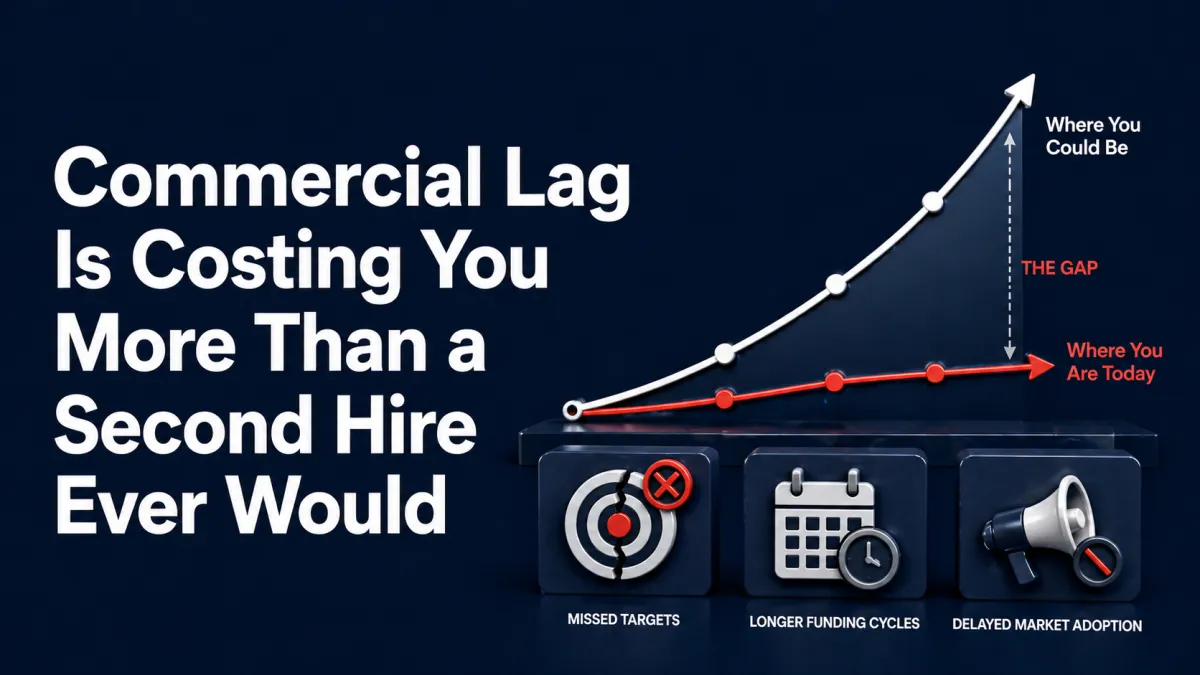
Commercial Lag Is Costing You More Than a Second Hire Ever Would
A founder I worked with had done everything right. Strong first commercial hire. Clean pipeline. Real traction in the market.
Six months in, the conversations were happening but the closes were not. Partners polite. Investors circling. Customers slow.
The hire was not underperforming. The function around the hire was incomplete. Commercial was running as a solo when the work needed two. And the lag between what the function could produce and what the market needed it to produce was costing the company more every quarter than a second role ever would have.
Commercial lag is the most expensive failure point in a life sciences organization. It does not show up as a line item. It shows up as deals that take far longer than they should. As partners who stay warm but never commit. As a pipeline that looks healthy until the quarter it does not.
Nobody in the advisory circle around a growing life sciences company is accountable for naming this. Investors are watching the data. The board is evaluating the business. Technical advisors are optimizing the process. None of them are tracking what commercial lag is actually costing. So it runs. And the gap quietly grows.
Why Commercial Is a Duet
Commercial is two kinds of work, done at the same time, by two different kinds of minds.
One role does. It runs the current book. Owns the active pipeline. Moves specific deals toward close. Sustains the relationships the company already has.
The other role builds. It shapes the position. Writes the narrative. Creates the market presence that precedes the sales conversation. Makes the company a name before the company becomes a meeting.
Ask one person to do both and you get half of each. The cadence of doing is incompatible with the cadence of building. The deals in front of you will always crowd out the position that brings the next deals in. That is not a failure of the hire. It is a structural impossibility.
When the building role runs in parallel with the doing role, the next pipeline arrives warmer than the last one. Deals that used to start at introduction start at interest. Deals that used to start at interest start at intent. The cost of the second role is fixed. The return compounds for the entire life of the company.
The Three Moves
The companies closing the commercial lag gap tend to make three moves in sequence.
Audit what the commercial function actually needs to produce at this specific stage. Not what a mature commercial function looks like eventually. What this company, at this moment, needs to deliver over the next twelve months.
Map which of those outputs the current commercial leader can realistically own at excellence. Most strong commercial leaders can own one side of the duet. The honest map exposes the other side.
Fill the other side deliberately. The building role does not have to be a full time hire. A fractional commercial leader, an advisory relationship, or a partner based engagement covers this side of the duet for most companies at this stage. The cost is a fraction of what the commercial lag was already costing.
The Question Worth Sitting With
What is commercial lag actually costing your organization right now? Not in theory. In deals that are taking longer than they should. In partners who are circling but not committing. In a market presence that has not kept pace with the quality of what you have built.
That number is almost always larger than the cost of the role that would have closed it.
That is where commercial ascent becomes repeatable. And that is where the duet pays for itself.
If this resonates, Commercial Gravity is the newsletter where these ideas live. New thinking lands every week for the CGT leaders building commercial position alongside the technology.
Susan Nichols is CEO and Managing Director of Propel Biosciences, a commercialization consultancy serving CDMOs, tools platforms, and diagnostics companies in the cell and gene therapy ecosystem.
